Quick answer: hair towel vs hair wrap
A hair towel is any towel used to dry hair. A hair wrap is purpose-built to sit on your head hands-free with a button or loop fastening. Hair wraps dry faster and cause less friction, which means less frizz, less breakage and both hands free while you figure out what to wear.
For most of human history, people dried their hair by rubbing it aggressively with whatever fabric was nearest. It worked. It also caused frizz, breakage and the specific look that hairdressers describe delicately as "mechanical damage" and that everyone else calls "why does my hair look like this."
There is a better way. Here is what it is.
What a hair towel actually is
A hair towel is broadly any towel used on wet hair. A regular bath towel qualifies. A microfibre travel towel qualifies. The problem is the rubbing motion most people use: wet hair is more fragile and elastic than dry hair, and friction from rough fibres causes the cuticle to lift, which is where frizz comes from.
A microfibre hair towel is a step up because the finer fibres draw moisture in rather than dragging it across the surface. Less friction, faster absorption, less frizz. Still requires active drying though.
What a hair wrap does differently
A hair wrap goes on immediately after washing. You twist your hair up into it, fasten the button or loop, and then get on with the rest of your morning. Zero rubbing. Zero friction. The wrap absorbs moisture continuously while you make coffee, find your keys and try to remember if today is a hat day.
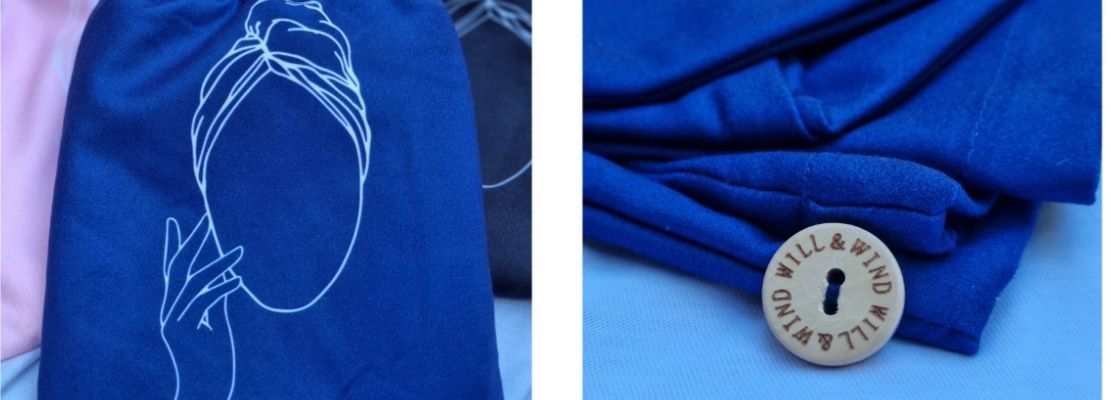
The Will and Wind hair wrap weighs under 100 grams, uses a button-and-loop fastening and dries in under an hour. It stays on through getting dressed, packing a bag and the general chaos of a morning routine without needing to be held in place.
We wrote about this properly in why microfibre hair wrap is the only one worth buying and it is still the most asked-about piece of content we have. People do not know this format exists and then cannot understand how they managed without it.
The frizz question
A hair wrap wins on frizz, not because of material alone but because of method. Zero friction during the absorption phase means the cuticle does not lift. This is particularly noticeable for wavy and curly hair types where the curl pattern gets disturbed by rubbing.
The wrap lets the natural curl or wave set while the moisture is being absorbed rather than fighting it. See why the right hair wrap changes your whole post-wash routine for more on technique.
Long and thick hair: does it work?
Yes, with method. Twist rather than bundle. Get the hair fully up into the wrap rather than loosely folded. Thick hair takes longer to dry in any format but the wrap still significantly reduces frizz compared to rubbing and speeds the early absorption phase that matters most for texture.
For the full technique including curly hair plopping, see how to wrap hair in a towel: the method that actually reduces frizz.
What to look for
Material: microfibre over terry cotton. A cotton hair wrap works but takes longer to dry itself and holds onto moisture longer, which means bacteria and smell develop faster. A microfibre wrap is dry again in under an hour.
Fastening: button-and-loop over elastic. Elastic loses tension and can pull at your hairline. A button-and-loop sits flat, holds firmly and does not stretch out over time.
Weight: under 100 grams. Heavier wraps pull on wet roots and fall off. A properly weighted microfibre wrap stays in place without thought.
FAQs
Can I use a travel towel as a hair towel?
Yes. The Will and Wind travel towel is microfibre and works well for hair. The hair wrap is purpose-built to sit hands-free and removes the friction entirely, which is the step up.
How long should I leave a hair wrap on?
Ten to twenty minutes. After twenty minutes the wrap has absorbed most of what it will and the rest benefits from air. You can leave it longer without any damage but the meaningful absorption is done by then.
Does a microfibre hair wrap work on very curly hair?
Yes, and often better than on straight hair because curly hair benefits most from no-friction absorption. Use the plopping method: bend forward, lower curls into the wrap, twist and secure. The curl pattern sets while drying rather than being disturbed.
How do I wash a microfibre hair wrap?
Cold machine wash, no fabric softener. Fabric softener coats microfibre fibres and reduces absorbency. Line dry or low tumble dry.
Is a microfibre hair wrap the same as a microfibre hair towel?
Not quite. Both are microfibre but the wrap is cut and shaped to sit hands-free with a fastening. A microfibre towel used on hair still requires active rubbing. The wrap removes that step entirely.
Shop the Will and Wind hair wrap. For more, read why microfibre hair wrap is the only one worth buying, why the right wrap changes your whole post-wash routine and hair wraps Australia: why microfibre beats cotton every time.